

The senior golf swing isn’t about compensating for age; it’s about adapting your mechanics to work with your body’s natural changes while maintaining consistency, accuracy, and the pure enjoyment of the game. The key shift involves prioritizing smooth tempo over raw power, maximizing rotation efficiency through proper sequencing, and adopting setup positions that reduce strain on your back, hips, and shoulders. Most golfers over 60 can improve both distance and accuracy within weeks by making three specific adjustments: widening their stance for better balance, allowing a fuller shoulder turn with a shorter backswing, and shifting to a more sweeping impact rather than a steep, downward strike.
The fairways you’ve walked for years don’t need to become distant memories. What changes is how you approach them. Your swing path, grip pressure, and weight transfer all benefit from thoughtful modification as flexibility decreases and joint health becomes paramount. The good news? Many senior golfers discover they hit straighter shots and enjoy lower scores once they stop fighting their swing and start working with it.
This guide walks you through each component of building a sustainable, effective swing tailored to the realities of an aging body. You’ll learn specific drills, setup positions, and swing thoughts that professional instructors recommend for golfers in their 60s, 70s, and beyond. Whether you’re playing a quick nine holes with family on a scenic course or competing in your club’s weekend tournament, these techniques help you stay confident, comfortable, and competitive. The focus remains where it belongs: on the beauty of the game, the camaraderie of your playing partners, and those satisfying moments when the ball flies true down the center of the fairway.
What You’ll Need to Transform Your Senior Golf Swing
Transforming your golf swing doesn’t require a garage full of expensive gear, but having the right tools and environment makes the process smoother and safer. Before you start reshaping your mechanics, you’ll want to gather a few essentials and consider whether your current equipment is working with you or against you.
Start with your clubs themselves. Many senior golfers continue using the same sticks they swung twenty years ago, and that’s often a mistake. As your swing speed decreases naturally with age, you need clubs that compensate rather than demand what you can no longer deliver. Consider a fitting session with a professional who can assess your current swing speed, tempo, and physical capabilities. You might benefit from lighter shafts with more flex, slightly longer clubs to accommodate a more upright stance, or larger clubheads with perimeter weighting that forgive off-center strikes.
For practice and feedback, you’ll need:
- Properly fitted clubs matched to your current swing speed and physical capabilities
- Alignment sticks or rods to check stance width, ball position, and swing path
- A full-length mirror or smartphone with video recording capability to review positions
- Access to practice facilities with both driving range and short game areas
- Optional training aids like tempo trainers, weighted clubs, or impact bags for specific drills
A practice facility with quality teaching spaces matters more than you might think. You need room to experiment without pressure, ideally with good lighting if you’re using video, and access to target greens for verifying results. The Lakes Golf Club offers practice areas designed for exactly this kind of focused work.
Professional instruction accelerates progress significantly. A qualified instructor familiar with senior swing mechanics can spot compensations you’ve developed over years, identify which physical limitations to work around versus which habits you can actually change, and give you a roadmap tailored to your body rather than a generic fix. Adult clinics and workshops provide structured learning with feedback from experienced instructors who understand the unique challenges aging golfers face.
Important Safety and Physical Considerations

Before you start reshaping your golf swing, understand that protecting your body matters far more than shaving strokes off your scorecard. The changes you’re about to make will challenge muscles and joints in new ways, and rushing the process invites injury that could sideline you for months.
Start every practice session with at least ten minutes of gentle movement. Walk around the practice area, swing a club slowly without a ball, and perform arm circles and torso rotations to increase blood flow to your shoulders and back. Research shows golfers who always warm up significantly reduce their injury risk, particularly in the rotator cuff and lower back where senior golfers face the greatest vulnerability.
Recognize that your flexibility and recovery time differ from a decade ago. If your hips resist a full turn or your shoulders feel tight at the top of your backswing, accept those limits rather than forcing through them. The swing modifications in this guide work precisely because they accommodate reduced range of motion instead of fighting it.
Schedule practice in shorter sessions rather than marathon ranges. Forty-five minutes of focused work beats two hours of repetition that leaves you stiff the next morning. Quality practice facilities provide the controlled environment you need for this gradual adaptation, good lighting, level surfaces, and space to work at your own pace without pressure.
If you’re managing arthritis, a previous shoulder injury, or chronic back issues, consult your doctor before making significant swing changes. A physical therapist familiar with golf movements can identify exercises that support your new technique while protecting vulnerable areas.
Step-by-Step: Building Your Senior Golf Swing
Step 1: Establish a Wider, Stable Stance
Your stance is the foundation of every golf swing, but for senior golfers, it needs to do double duty: provide rock-solid balance while allowing your hips and shoulders to turn freely. Start by positioning your feet shoulder-width apart or slightly wider, this creates a stable base that reduces the risk of losing balance during rotation. Unlike the narrower stances you may have used in your younger years, this wider setup lets you coil your upper body without straining your lower back or knees.
Weight distribution matters more than you might think. Place about 60 percent of your weight on your lead foot (left foot for right-handed golfers) at address. This slight forward bias helps you maintain balance through impact and encourages a natural weight shift without forcing it. For ball position, move the ball slightly forward in your stance for longer clubs, just inside your lead heel works well for drivers, and progressively back toward center for mid-irons and wedges.
Keep your knees flexed but not over-bent; you want an athletic posture, not a deep squat. This stance feels stable immediately, and it sets you up for the compact, efficient backswing you’ll develop in the next step.
Step 2: Simplify Your Backswing for Better Consistency
The shorter you make your backswing, the more consistent your ball-striking becomes. Senior golfers often try to match the shoulder turn they had decades ago, creating tension and inconsistent contact. Instead, focus on a three-quarter backswing that keeps your left arm comfortably extended without strain.
Stop your backswing when your lead shoulder reaches your chin, not when your hands reach parallel to the ground. This natural stopping point maintains coil without forcing rotation your body can’t comfortably provide. Your hips should rotate only fifteen to twenty degrees, far less than your shoulders, creating the differential that generates power efficiently.
Maintaining your spine angle throughout the backswing is critical. Imagine a rod running from your head down through your tailbone and keep that angle constant as you turn. When you stand up or dip during the backswing, you’ll need compensations on the way down that kill consistency.
The compact backswing shares principles with the single-plane swing emphasizing simplicity and repeatability over maximum coil. Practice stopping at three-quarters and holding that position for three seconds. If you feel strain or can’t hold the pose comfortably, you’ve gone too far. Your new backswing should feel controlled and effortless, not restricted.
Step 3: Master the Transition and Tempo

The transition, that split second between your backswing and downswing, is where senior golfers often lose power by rushing. Instead of yanking the club down aggressively, think “one-two” tempo: complete your backswing, pause for a heartbeat at the top, then let your lower body initiate the downswing while your arms and club lag slightly behind. This sequencing creates a whip effect that generates clubhead speed without requiring you to swing harder.
Count silently as you swing: “one” for the backswing, a brief hesitation at the top, “two” for the downswing. The pause isn’t a full stop, just a subtle shift in direction that allows your weight to begin transferring to your front foot before your arms start down. Many senior golfers find success with a 2:1 backswing-to-downswing tempo ratio, twice as long going back as coming down, which promotes smoothness and prevents the rushed, choppy action that causes mishits and strain on your shoulders and back. Practice this rhythm with half-swings until the sequencing feels natural, then gradually work up to full swings while maintaining that same unhurried cadence.
Step 4: Generate Power Through Rotation, Not Force
The secret to distance as a senior golfer isn’t swinging harder, it’s letting rotation do the heavy lifting. Your hips and torso can generate surprising clubhead speed when you sequence them properly, sparing your back and shoulders from the strain of forced power.
Start your downswing by rotating your hips toward the target, not by yanking your arms down. Think of your lower body leading the way: as your hips clear, your torso follows, then your arms, then the club. This chain reaction, combined with proper weight transfer from your back foot to your front foot, multiplies the energy you’re putting into the shot without requiring explosive effort.
The key is letting the club release naturally rather than steering it through impact. As your body rotates, your wrists unhinge on their own, whipping the clubhead through the ball. Many senior golfers make the mistake of holding on too tightly or trying to muscle the club, which actually slows it down. Professional driver swing mechanics demonstrate this principle beautifully: elite players generate power through efficient rotation and timing, not brute strength.
Practice this feel with half-swings first. Focus on the sensation of your hips turning smoothly while your arms remain relaxed. When you trust the rotation, distance follows naturally.
Step 5: Complete Your Follow-Through with Balance

A balanced follow-through is your swing’s receipt, proof that you’ve transferred your weight properly and rotated efficiently without forcing the issue. After contact, allow your body to continue turning until your chest faces the target. Your weight should settle almost entirely on your front foot, with your back heel naturally lifting and your back toe barely touching the ground for light support.
Hold this finish position for at least two seconds. If you wobble or need to take a step, your rotation was either too aggressive or your weight transfer incomplete. Your spine angle should remain relatively consistent from address through finish, avoid the common senior mistake of standing up too quickly, which throws off balance and robs you of power.
Watch for over-rotation: your belt buckle should point at the target, not past it. Excessive twist strains your lower back and hips without adding distance. Think of the follow-through as controlled momentum rather than forced effort. A smooth, balanced finish you can hold comfortably indicates your new senior swing mechanics are working together as intended.
Refining Your Short Game: Chipping and Putting
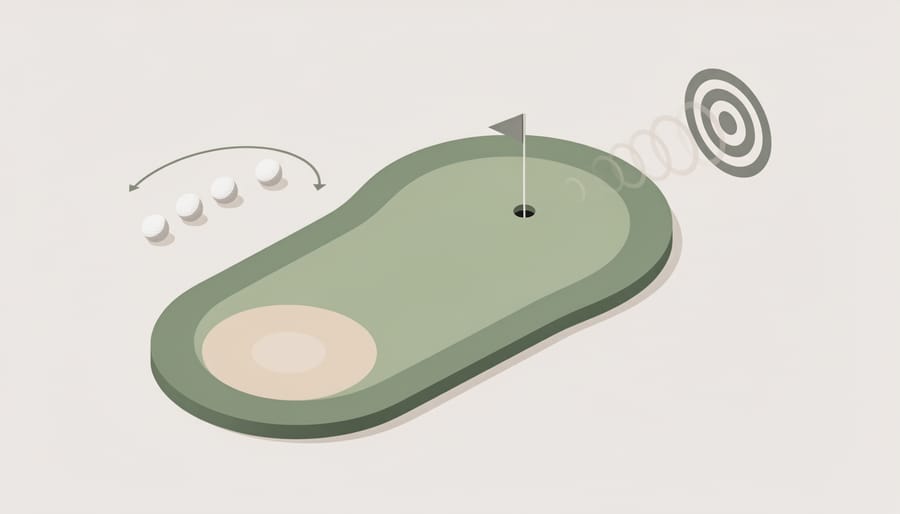
The same senior-friendly principles that improve your full swing apply around the greens, where touch and consistency matter more than power. For chipping, narrow your stance slightly and position the ball back of center, keeping your weight favoring your front foot throughout the stroke. Use a pendulum motion with your shoulders rather than flipping your wrists, this creates reliable contact and eliminates the thin and fat shots that plague many senior golfers. Keep your backswing compact and let the loft of the club do the work.
With putting, focus on tempo and rhythm over mechanics. A longer, slower stroke produces better distance control than a quick jab, and minimizing wrist movement keeps the putter face square through impact. Grip pressure should stay light, tension in your hands travels up your arms and disrupts your natural feel. Practice lag putting to three-foot circles rather than obsessing over holing everything; this builds confidence and reduces three-putts. The short game rewards patience and repetition, and dedicating practice time to these finesse shots often drops more strokes than chasing distance off the tee.
Practice Drills to Groove Your New Swing
Practicing your new senior swing requires targeted drills that reinforce the mechanics without strain. You don’t need hours on the range, three focused sessions a week, even just 20 minutes each, will yield noticeable improvement. The key is quality repetition that builds muscle memory for the simplified, rotation-based swing you’ve learned.
Start your practice with these foundational drills that address the core elements of a senior-friendly swing:
- Slow-motion swings: Take 30-second swings focusing entirely on sequence and balance, not speed, this builds proper movement patterns without fatigue
- One-arm drills: Swing with your lead arm only to feel the proper rotation and prevent over-reliance on hand strength
- Step-through drill: Start with feet together, step forward with your lead foot during the downswing to groove weight transfer and finish in balance
- Mirror work: Practice your setup and backswing position in front of a mirror or large window to verify spine angle and shoulder turn
The tempo drill deserves special attention. Place three balls in a row, about six inches apart. Hit each ball in succession without pausing between swings, maintaining the same smooth rhythm for all three. This drill prevents you from rushing and reinforces the consistent tempo that generates reliable contact. If you’re speeding up or losing balance, you’re defeating the purpose, reset and start slower.
For rotation practice, try the feet-together drill: address the ball with your feet touching, then make a full swing. You’ll immediately feel how much your swing depends on rotation rather than lateral movement or arm strength. Start with half swings and gradually work up to full swings as your balance improves. Most senior golfers discover they can hit the ball surprisingly well from this position once they trust their rotation.
The alignment stick drill helps with both setup and swing path. Place a stick on the ground pointing at your target, then position another across your toes. This visual reference keeps your body aligned correctly and prevents the common senior tendency to aim right and compensate with an over-the-top swing path.
How to Know Your Swing Is Working (and What’s Next)
You’ll know your swing changes are working when you start seeing tangible results on the course. Look for straighter ball flight, even if you’re not yet hitting it farther, consistency beats distance every time. Better contact means you’ll hear that satisfying click at impact rather than feeling vibrations through the shaft. Your shots should feel effortless, not forced.
Track your scores over several rounds. If your handicap drops or your typical bad holes become less catastrophic, your swing adjustments are taking hold. Pay attention to how your body feels after eighteen holes. Less shoulder pain, reduced lower back stiffness, and the ability to walk off the course without feeling exhausted all signal that your new mechanics are protecting your body while improving your game.
Keep a simple practice journal noting what feels good and what doesn’t. Jot down distances with each club every few weeks to spot trends. If you’re seeing steady improvement but want to accelerate your progress, professional instruction can identify subtle issues you might miss on your own. Many golf facilities offer adult clinics designed for skill development, programs like those at Cardinal Golf Complex feature five one-hour lessons with a 1:6 student-to-CPGA instructor ratio, running Tuesday or Thursday for around $300 plus tax.
Regular practice at quality facilities not only sharpens your swing but also supports overall fitness. The combination of walking the course and practicing proper mechanics can help you lose weight with golf while enjoying the game you love. When your swing feels natural, your scores improve, and you’re playing pain-free, you’ve successfully adapted your game for long-term enjoyment.
Common Questions About Senior Golf Swings
What’s the ideal swing speed for senior golfers?
There’s no single ideal speed, but most senior golfers generate between 70-85 mph with the driver. Focus on consistency and rhythm rather than chasing a specific number, as efficiency and solid contact matter more than raw speed for distance and accuracy.
Should I switch to senior-specific clubs?
Senior flex shafts and lighter club heads can help if you’ve noticed a significant decrease in swing speed or struggle to get the ball airborne. A proper fitting session will reveal whether equipment changes complement your swing mechanics or if technique adjustments should come first.
How long does it take to see improvement in my swing?
Most golfers notice better ball striking within two to three weeks of consistent practice, though embedding new motor patterns typically requires four to six weeks. Programs like the Adult Golf Clinics at Cardinal Golf Complex, which offer five one-hour lessons every Tuesday or Thursday with a 1:6 student-to-CPGA instructor ratio for $300 plus HST, provide structured timelines for developing these changes with professional feedback.
Is it okay to practice my new swing on the course, or should I stick to the range?
Work out the major kinks on the practice range first, then gradually introduce the changes during casual rounds when pace of play won’t suffer. If you’re testing significant adjustments mid-round, let faster groups play through and choose less crowded times to learn how to play courses with your evolving technique.
Beyond these common questions, remember that every golfer’s journey is different. If you’re experiencing persistent pain or your swing feels fundamentally broken despite practice, seeking professional instruction accelerates progress and prevents ingraining compensations that lead to injury. Many senior golfers find that a single lesson identifies the key issue holding them back, whether it’s grip pressure, weight shift, or simply trying to swing too hard. Workshops like those at Burnaby Golf Academy provide group settings where you can learn alongside peers facing similar challenges, often making the process less intimidating than one-on-one instruction.
The most successful senior golfers treat swing development as an ongoing process rather than a problem to solve once and forget. Your body continues changing, weather conditions vary, and different courses demand adjustments, so maintaining curiosity about your swing keeps the game engaging while protecting against stagnation or frustration.
Adapting your golf swing as a senior isn’t about recapturing the distance of your youth, it’s about discovering a more sustainable, effective way to play the game you love. By prioritizing balance, rotation, and timing over brute force, you protect your body while often improving consistency and accuracy. The techniques outlined here work because they align with how your body naturally moves, turning physical changes from obstacles into opportunities for smarter golf.
The journey to a refined senior swing takes patience and the right practice environment. Quality facilities with dedicated practice areas, supportive instruction, and a welcoming atmosphere make all the difference. The Lakes Golf Club provides the kind of setting where senior golfers can work through these swing changes at their own pace, surrounded by scenic beauty and fellow enthusiasts who share the same goals. Whether you’re grooving your new tempo on the range or testing your balanced finish on the course, having a comfortable home base accelerates progress.
Golf remains one of the few sports you can enjoy and improve at for decades. With body-friendly mechanics, consistent practice, and occasional professional guidance, there’s no reason your best golf can’t still be ahead of you. The swing you build today can carry you through countless memorable rounds, proving that efficiency and longevity beat power every time.