
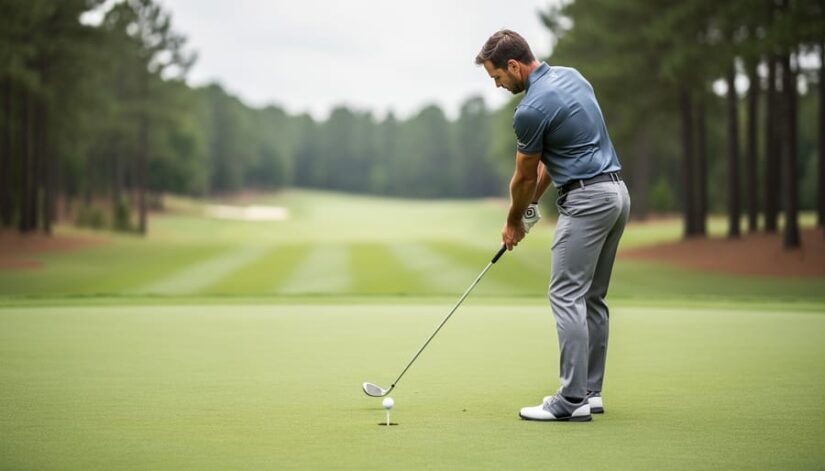
The single plane golf swing is a simplified technique where your club stays on a single geometric plane from address through impact, pioneered by the legendary ball-striker Moe Norman and now taught systematically at specialized schools. Instead of the two-plane method most golfers learn, where the backswing and downswing follow different paths, this approach keeps your hands, arms, and club traveling along one consistent angle. The result? More repeatable contact, straighter shots, and less need for compensatory movements during the swing.
The single plane method feels dramatically different at first. You’ll set up with a wider stance, stand farther from the ball, and grip the club with both palms facing each other rather than in the traditional overlapping position. Your lead arm and the club shaft form a straight line at address, a relationship that stays intact throughout the motion. This creates a swinging action that’s more rotational than the conventional lifting and dropping motion taught in most golf instruction.
Learning this technique typically takes dedicated practice over several weeks, though many golfers report hitting cleaner shots within their first session once they understand the fundamentals. Graves Golf operates specialized Single Plane Golf Schools offering intensive one-day instruction immersing students in the core elements: Moe Norman’s grip, address position, impact dynamics, and finish. These hands-on sessions condense what might take months of trial and error into focused, personal training.
The appeal is simple. Fewer moving parts mean fewer things that can go wrong mid-swing, especially valuable when you’re standing over a shot with pressure mounting or trying to find consistency after time away from the course.
What You’ll Need to Learn the Single Plane Swing
Learning the single plane golf swing requires less equipment than you might think, but success depends on combining the right physical tools with a realistic mindset and proper guidance. Unlike traditional instruction that often layers technique upon technique, this method strips the swing down to its fundamental geometry, which means your preparation looks different from the start.
At minimum, you’ll need:
- Golf clubs with lie angles suited to single plane mechanics (or your current irons for initial learning)
- Access to a practice facility where you can hit full shots without constraint
- A smartphone or camera capable of recording your swing from multiple angles
- Mental readiness to temporarily unlearn conventional swing thoughts and patterns
- At least several dedicated practice sessions to internalize the fundamentals
The mental preparation matters as much as the physical tools. Golfers who’ve spent years grooving a traditional swing often struggle initially because the single plane setup feels unfamiliar, even awkward. Your hands sit differently, your posture changes, and your swing path follows a line that contradicts what you’ve practiced. This discomfort is normal and temporary, but it requires patience and willingness to trust the process rather than revert to old habits after a few poor shots.
Hands-on instruction proves particularly valuable for this technique because the single plane swing is as much about feel and geometry as it is about mechanics. Graves Golf operates dedicated single plane golf schools that immerse students in the Moe Norman fundamentals through personal training sessions, typically structured as one-day intensive programs. These schools focus specifically on the grip, address position, impact, and finish that define the method. While video instruction and written guides provide helpful reference points, having an experienced instructor physically adjust your setup and monitor your swing plane accelerates learning and prevents the formation of compensating movements that undermine the technique’s simplicity.
Important Considerations Before You Start
Switching to the single plane swing represents a fundamental change in your golf mechanics, not a minor adjustment. Expect the movement to feel awkward and unnatural for several weeks as your body adapts to positions that contradict years of conventional swing patterns. This discomfort is normal and temporary, but pushing through pain is not, if you experience sharp discomfort in your lower back, lead shoulder, or wrists, stop immediately and reassess your setup and execution. Many golfers transitioning to this method report muscle soreness in unexpected areas as they engage different stabilizers and rotate differently through impact.
The most common pitfall is expecting immediate results. Your handicap may temporarily increase as you rebuild your swing from scratch, and ball flight consistency often worsens before it improves. Resist the temptation to revert to old patterns when pressure mounts during a round. This learning process demands patience, repetition, and ideally several months of dedicated practice before you’ll see reliable improvement on the course. If you’re looking for physical benefits beyond swing mechanics, activities like regular walking while practicing can help you lose weight with golf while ingraining these new movement patterns. Watch for swing faults that develop from improper execution, particularly an overly flat backswing or failure to extend through impact, both of which undermine the single plane geometry you’re trying to establish.
The Four-Step Single Plane Swing Process
Step 1: Master the Single Plane Grip
The single plane grip represents the most fundamental departure from conventional instruction, and getting it right from the start prevents countless hours of frustration later. Unlike a traditional grip where your hands work somewhat independently, the single plane grip unifies both hands into a single lever that moves the club along one consistent plane.
Start by holding the club in front of you at waist height with your lead hand (left hand for right-handed golfers). Position your palm facing the target rather than angled toward the sky as in a conventional grip. The club runs diagonally across your palm from the base of your pinkie finger to just below the pad of your index finger. When you close your hand, your thumb sits slightly right of center on the grip, not directly on top.
Your trail hand mirrors this palm-facing-target orientation. The lifeline of your trail hand covers your lead thumb completely, creating maximum unity between the hands. Both palms face each other and point toward the target, forming what feels like a single unit wrapped around the club.
The pressure points differ markedly from traditional grips. You’ll feel tension primarily in the last three fingers of your lead hand and the middle two fingers of your trail hand, not in your thumbs and forefingers. This pressure distribution naturally keeps the club extended away from your body throughout the swing.
To verify proper positioning, hold the club at address and check that both thumbs point down the shaft toward the clubhead, not at angles. Your wrists should feel flat and tension-free, not cupped or bowed. When you waggle the club, it should move as one piece with your arms, maintaining its relationship to your body without independent hand action.
Step 2: Set Up Your Address Position
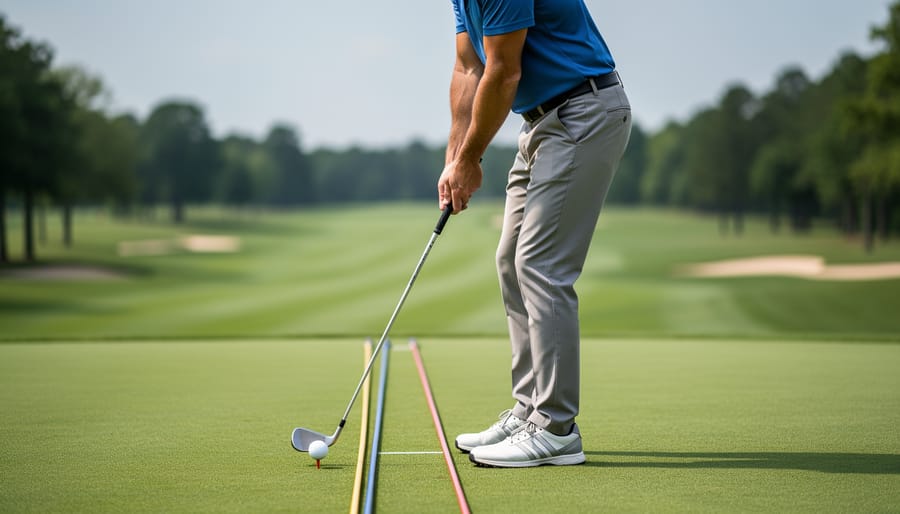
The address position sets the foundation for every single plane swing you’ll make. Get this wrong, and you’ll fight the technique through every stage of motion. Get it right, and the rest falls into place with surprising ease.
Start with your feet positioned wider than you might expect, about shoulder width or slightly beyond for mid-irons. This wider base provides the stability needed for the rotational movement that comes later. Your weight should feel evenly distributed between both feet, with just a hint more pressure on your lead side.
Ball position moves forward compared to traditional instruction. For a seven-iron, place the ball roughly opposite your lead shoulder rather than in the center of your stance. This forward position aligns with the single plane geometry where the club approaches impact on a shallower arc.
Here’s the setup sequence that locks everything into place:
- Set your feet shoulder-width apart with toes flared slightly outward
- Position the ball forward in your stance, opposite the lead shoulder for mid-irons
- Stand tall with minimal knee flex, feeling your weight centered over the balls of your feet
- Extend both arms fully from your shoulders, creating a straight line from lead shoulder through the clubhead
- Let the club rest naturally on the ground with the shaft pointing at your belt buckle
- Check that your hands hang directly below your shoulders without reaching forward
The arm extension proves critical. Unlike conventional swings where you bend your lead arm or pull your hands inward, the single plane demands both arms stay fully extended. This creates the wide arc that maintains the plane throughout your motion.
Notice how the club sits differently, the shaft appears more upright at address than in traditional setups. This upright shaft angle represents the actual plane you’ll swing through. Your spine angle stays relatively upright too, without the deep forward tilt many golfers have been taught.
Step 3: Execute Through Impact
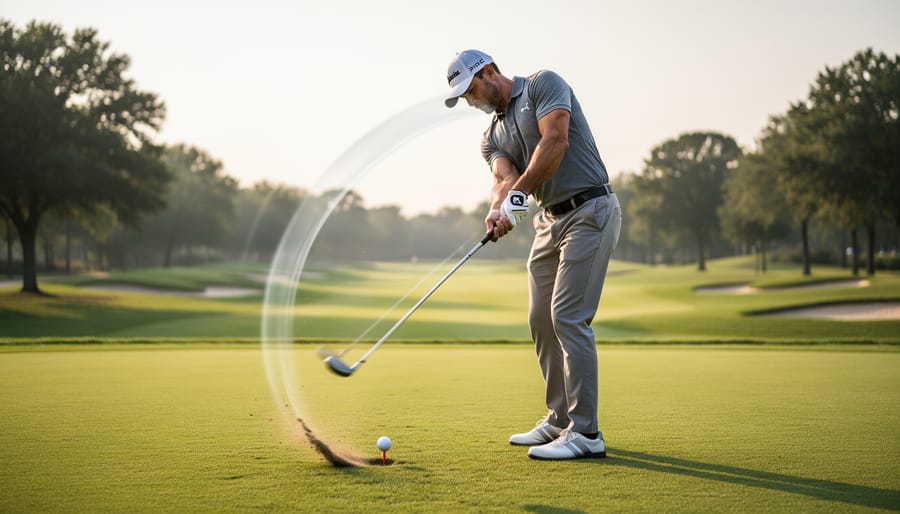
Impact is where the single plane swing reveals its elegant efficiency. Unlike traditional methods that require precise timing to square the clubface, the single plane geometry does this work for you, if you’ve maintained the fundamentals from address.
As you rotate through the ball, your lead arm remains extended on the same angle it held at address. This extended arm position is critical: collapsing or bending the lead elbow destroys the single plane and introduces the timing issues you’re trying to eliminate. Your trail arm naturally extends toward the target as your body rotates, creating the distinctive “reaching” sensation through impact that characterized Moe Norman’s swing.
Your body rotation drives everything. The hips continue turning toward the target while your shoulders follow, but the arms don’t manipulate the club independently. This feels radically different from conventional instruction that emphasizes hand action through impact. In the single plane method, your hands are essentially passengers, the body turn and extended arms control the clubface.
The club path stays on plane because you’ve kept that extended lead arm relationship. The clubface squares naturally to this path because the geometry established at address hasn’t changed. You’re not flipping, rolling, or timing anything with your hands.
Common errors include trying to help the ball up by scooping (collapsing the lead arm) or adding wrist manipulation. Proper contact produces a crisp, compressed strike with divots starting at or slightly ahead of the ball position. The ball compresses against the clubface rather than being scooped or swept.
Step 4: Complete the Finish Position
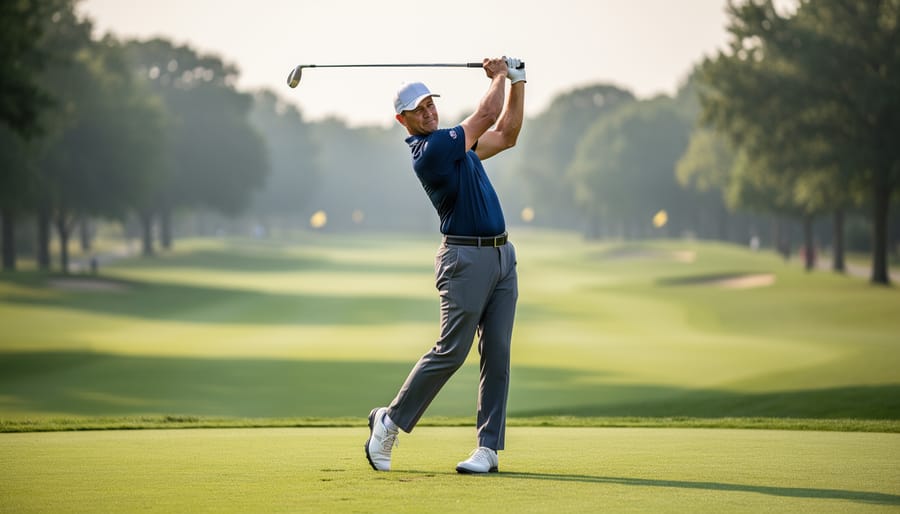
The finish position in the single plane swing is distinct and unmistakable, your weight should be fully transferred to your front foot, with your back heel lifted and only the toe touching the ground. Your chest faces the target, and crucially, your arms extend straight out from your body rather than wrapping around like in a conventional finish. This extended arm position is a direct result of maintaining the single plane throughout the swing; if your arms collapse or pull across your chest at the finish, you’ve likely deviated from the plane somewhere in your motion.
Your balance at the finish serves as immediate feedback. You should be able to hold this position comfortably for several seconds without swaying or adjusting. If you’re falling backward or struggling to maintain stability, it indicates timing issues or weight transfer problems earlier in the swing. The club shaft should point roughly toward the target line, with the clubface visible and your hands finishing high, not tucked low near your shoulder as you might see in traditional methods.
Think of the finish as your swing’s report card. A proper single plane finish tells you that your grip remained constant, your address position was sound, and your impact geometry stayed true to the method. When practicing, pause deliberately at your finish position after each swing. Ask yourself: Am I balanced? Are my arms extended? Is my body fully rotated? These checkpoints reveal whether you’ve executed the previous three steps correctly or where you need to focus your practice attention.
Applying the Method to Your Individual Swing Faults
The single plane swing’s simplified geometry addresses many common faults by eliminating the compensations required in traditional two-plane swings. If you struggle with a slice, the single plane method keeps your club path naturally on-plane and your arms extended through impact, reducing the out-to-in cutting motion that creates sidespin. The extended lead arm and connected rotation make it harder to flip your wrists or manipulate the clubface, which are the primary slice causes in conventional swings.
For those fighting a hook, the single plane swing’s wider arc and consistent plane angle prevent the excessive inside-out path and closed clubface position that produce hooks. Your setup naturally positions the club more open at address, and the single plane motion maintains that relationship through impact without requiring timing-dependent hand manipulation. Many golfers find their chronic hook disappears within a few practice sessions once they commit fully to the single plane grip and address position.
Inconsistent contact typically stems from variations in swing plane and clubface angle at impact. The single plane method reduces these variables by keeping your club on a consistent geometric path. Your extended arms and simple rotation mean the club returns to nearly the same position every time, producing more centered strikes without conscious effort. Understanding proper weight transfer helps maintain balance throughout this motion.
If you’ve lost distance, the single plane swing’s efficiency often restores it by reducing energy leaks from excessive hand action and plane shifts. The method’s wide arc and connected body turn create clubhead speed through leverage rather than manipulation. Those accustomed to driver swing basics from conventional instruction may need several weeks to trust the single plane approach, but distance typically returns as the new pattern becomes automatic. Practice each position methodically rather than expecting overnight transformation.
How to Verify Your Progress and Next Steps
You’ll know you’re executing the single plane swing correctly when specific performance patterns emerge on the range. Start by recording short videos of your swing from face-on and down-the-line angles, then compare them against the four fundamental checkpoints: your grip hasn’t shifted from the single plane position, your address mirrors the setup you’ve drilled, your impact shows extended arms with the clubface square, and your finish displays the characteristic balanced rotation. These visual checks confirm you’re maintaining the geometry, not just approximating it.
Ball flight tells the most honest story. Consistent, repeating shot patterns, even if they’re draws or slight fades, indicate you’ve ingrained the mechanics. You should see:
- Straighter initial ball flight with predictable curvature rather than random slices or hooks
- Solid contact in the center of the clubface most shots, evidenced by feel and ball mark pattern
- Fewer swing thoughts during execution as the motion becomes instinctive
- Improved distance control with irons, hitting consistent yardages shot after shot
When these markers appear reliably over multiple practice sessions, you’ve crossed from learning to owning the technique. At this stage, take your swing to real course conditions where uneven lies, wind, and pressure test what you’ve built. Premier facilities like The Lakes Golf Club provide ideal proving grounds, the varied terrain and well-maintained fairways let you apply single plane fundamentals in actual playing situations, not just controlled range environments.
Maintain progress through focused repetition rather than constant tinkering. Dedicate two practice sessions weekly to pure single plane drills: grip checks, address rehearsals, slow-motion swings emphasizing the impact position. If inconsistency creeps back or old habits resurface after several weeks, that’s when to seek additional instruction. A single refresher lesson often corrects small deviations before they become ingrained faults. Consider entering an amateur tournament once you’re confident, competitive rounds reveal whether your swing holds up under scrutiny and provide motivation to keep refining the method.
Common Questions About the Single Plane Golf Swing
How long does it take to learn the single plane swing?
Most golfers need several weeks of consistent practice to develop muscle memory for the fundamentals, though you can begin hitting solid shots within a few sessions. Graves Golf’s single plane schools offer immersive one-day programs that teach the core elements, grip, address, impact, and finish, in a concentrated format, after which ongoing practice refines the technique.
Can beginners start with the single plane method?
Beginners often adapt more quickly than experienced golfers because they haven’t ingrained traditional swing patterns. The simplified mechanics make it an excellent starting point, though any golfer willing to commit to the learning process can transition successfully.
Do I need special clubs to hit a single plane swing?
You can learn and play the single plane swing with standard equipment, though many golfers eventually switch to single-length irons designed for the method. Start with your existing clubs while learning the fundamentals, then evaluate whether specialized equipment suits your game once you’ve mastered the basics.
Is the single plane swing suitable for seniors or juniors?
The method works well for both groups because it requires less rotation and timing than traditional swings, reducing physical strain while maintaining consistency. Juniors benefit from the simpler learning curve, while seniors appreciate the reduced stress on the back and joints.
The single plane swing differs from traditional methods primarily in geometry and simplicity. Where conventional instruction teaches shifting planes and complex sequencing, the single plane approach keeps the club on one continuous arc from start to finish. This reduces the variables you need to control and eliminates the timing challenges that cause inconsistency in multi-plane swings. The trade-off is an initial adjustment period where the setup and finish positions feel unfamiliar, but once ingrained, the motion becomes more repeatable than methods requiring perfect coordination of multiple moving parts.