

Wrist hinge in the golf swing refers to the controlled cocking motion of your wrists during the backswing and downswing, where the angle between your forearm and the club shaft narrows and then releases, creating clubhead speed and power. This fundamental movement separates casual golfers from those who strike the ball with authority and consistency. When properly executed, wrist hinge stores energy like a coiled spring, releasing through impact to generate effortless distance without the need for muscular force or overswing.
The mechanics are simpler than most golfers expect. Your lead wrist (left for right-handed players) hinges upward while your trail wrist cups slightly on the backswing, forming an “L” shape between your arm and the shaft. At impact, this relationship reverses as the club releases through the ball. The challenge isn’t understanding the concept but training your body to perform the motion naturally, without forcing or manipulating the clubface.
This article breaks down exactly how wrist hinge works for every club in your bag, the different types of wrist action you’ll encounter, and proven drills that are helping golfers add distance and accuracy in 2026. Whether you’re just beginning to explore swing fundamentals or refining technique to eliminate inconsistent contact, you’ll find clear explanations and practical exercises you can use on the range today.
What Wrist Hinge Means in Your Golf Swing
Wrist hinge is the natural cocking motion your wrists make during the backswing, creating an angle between the club shaft and your forearms. Picture the letter “L” formed by your lead arm and the club shaft as you swing back. This angle stores energy that releases through impact, generating clubhead speed and power without forcing or swinging harder.
When you hinge your wrists properly, you’re letting them bend naturally upward as the club moves away from the ball. Your lead wrist (left for right-handed golfers) cups slightly while your trail wrist begins to bend back, setting the club into position. This motion happens gradually throughout the backswing, not as a sudden flip or manipulation.
To understand wrist hinge fully, it helps to know these essential terms:
- Lead Wrist
- The wrist closest to your target (left wrist for right-handed golfers) that controls clubface angle and maintains stability through impact.
- Trail Wrist
- The rear wrist (right for right-handed golfers) that creates the hinge angle and releases stored energy through the ball.
- Hinge
- The upward cocking motion of the wrists during the backswing that sets the club into position and stores potential energy.
- Rehinge
- The secondary hinging motion that occurs after impact as the club swings through to the finish, maintaining lag and power delivery.
- Clubface Square
- When the clubface points directly at the target at impact, producing straight shots rather than slices or hooks.
Wrist hinge is fundamental because it allows you to generate distance with less physical effort. Without proper hinge, you’re forced to muscle the club using only arm strength and body rotation. With it, you tap into a natural lever system that multiplies your power. Every effective golf swing relies on this motion, whether you’re hitting a driver off the tee or a wedge into the green.
How Wrist Hinge Works in the Swing

The Lead Wrist’s Role
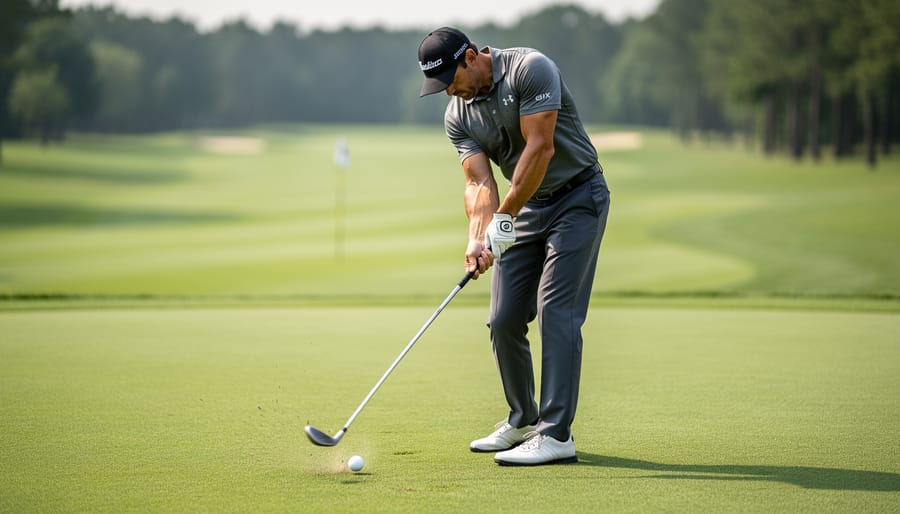
The lead wrist acts as the steering wheel of your golf swing, dictating where the clubface points at impact. For right-handed golfers, the left wrist maintains a flat or slightly bowed position from the top of the backswing through contact with the ball. This stable structure prevents the clubface from rotating open or closed during the critical moment when club meets ball. When the lead wrist breaks down and cups, the clubface opens, sending shots right of target. Conversely, excessive bowing can close the face and produce hooks. The lead wrist works in tandem with the trail wrist to create the wrist hinge power release that generates speed while keeping directional control. Think of your lead wrist as the foundation that holds everything together while your trail wrist supplies the power.
The Trail Wrist’s Role
The trail wrist (right wrist for right-handed players) acts as the power generator in your swing. During the backswing, it bends back naturally, creating that crucial angle between your forearm and the club shaft. This hinge loads energy you’ll release through impact.
Think of it like cocking a hammer. Your trail wrist sets the angle early in the backswing, maintains it at the top, then unleashes stored power as you swing down. The release happens naturally when your wrists unhinge and rehinge through the ball, squaring the clubface and multiplying clubhead speed without forced effort.
What makes this work is harmony. Your trail wrist can’t operate alone. It must coordinate with your lead wrist throughout the entire sequence, from driver to wedge. When both wrists hinge and rehinge together in rhythm, you get consistent strikes, straighter shots, and that effortless distance good swings produce. Fight this natural motion or try to muscle the club, and you’ll lose both power and accuracy.
The Hinge and Rehinge Sequence

The backswing hinge sets up everything that follows. As you take the club back, your wrists naturally cock upward, creating that crucial angle between the shaft and your forearms. This isn’t a forced manipulation, it happens as a response to the club’s weight and your body rotation. The key is maintaining this angle at the top of your swing rather than letting it collapse early.
The magic happens on the downswing. While many golfers try to hold the hinge as long as possible, the real sequence involves a rehinge through impact. As you initiate the downswing with proper weight transfer and body rotation, the wrists begin to release. But here’s what separates powerful ball strikers from the rest: immediately after impact, the wrists rehinge on the follow-through side, creating a mirror image of the backswing position.
This hinge-rehinge sequence does two critical things. First, it generates effortless clubhead speed without requiring you to swing harder or faster. Second, it squares the clubface naturally through the hitting zone, producing straighter shots with better compression. When you understand this motion, you stop fighting your swing and start working with the natural mechanics your body wants to create.
Different Types of Wrist Action
Not every golfer hinges their wrists the same way, and understanding these variations helps you find what works for your body and swing style. The timing, angle, and degree of wrist hinge can differ based on swing philosophy and the club you’re using.
The most common distinction is between early hinge and late hinge. An early hinge means your wrists cock sooner in the backswing, creating the angle within the first few feet of the takeaway. This approach can help shorter backswing players generate more power. A late hinge delays that cocking motion until later in the backswing, often seen in players with a one-piece takeaway where the arms, shoulders, and club move together initially before the wrists hinge near the top. Some instructors connect this one-piece approach to methods like the single plane swing which emphasizes fewer moving parts.
Common wrist hinge variations include:
- Early hinge, wrists cock within the first few feet of takeaway
- Late hinge, wrists cock closer to the top of the backswing
- One-piece takeaway, arms and club move together before hinging
- Cupped wrist position, lead wrist bends back slightly
- Bowed wrist position, lead wrist angles slightly forward
- Neutral wrist position, flat alignment through impact
Wrist action also varies by club. Your driver swing mechanics typically feature a fuller wrist hinge to maximize clubhead speed, while wedge shots often use a more controlled, abbreviated hinge for precision. Natural wrist hinge responds to the weight and momentum of the club, allowing gravity and swing arc to create the angle. Forced manipulation, by contrast, means consciously adding or restricting wrist motion beyond what the swing naturally produces, which usually leads to inconsistency and tension.
How Golfers Use Wrist Hinge to Improve Their Game
Proper wrist hinge transforms golfers’ swings by unlocking three powerful benefits that work together to elevate every shot. When you master the hinge and rehinge sequence, you’ll generate significantly more clubhead speed without swinging harder or straining your body. The stored energy from a clean wrist hinge releases naturally through impact, creating what many golfers describe as effortless power, the club does the work while you maintain smooth tempo and rhythm.
Beyond distance, correct wrist hinge dramatically improves ball-striking consistency. The rehinge through impact helps square the clubface precisely when it matters most, reducing the slices and hooks that plague inconsistent swings. You’ll notice tighter shot dispersion and straighter ball flight as your clubface arrives at impact in the same position swing after swing. This consistency stems from your wrists working together naturally rather than manipulating the club with your hands.
The beauty of proper wrist hinge is that it scales across your entire bag. Whether you’re hitting driver off the tee or wedge into a green, the same fundamental wrist action applies. Golfers at every skill level benefit, beginners establish sound mechanics from the start, while experienced players often find that refining their wrist hinge eliminates compensations they’ve built over years. The drills gaining attention right now focus on this universal application, teaching you to feel the correct hinge position so it becomes automatic with any club you grab.
Proven Drills to Master Your Wrist Hinge
Mastering wrist hinge doesn’t require complicated drills or expensive equipment. The techniques gaining traction among instructors focus on simple, repeatable exercises you can practice anywhere, from your living room to The Lakes Golf Club’s practice facilities.
The ‘L’ drill has become particularly popular for teaching proper hinge position. Start by taking your setup position with a club. As you begin your backswing, focus on creating an ‘L’ shape between your lead arm and the club shaft when your hands reach hip height. Your lead wrist should cock naturally upward while maintaining the angle. This visual checkpoint helps golfers understand the proper hinge angle without overthinking the mechanics. Practice this motion slowly, stopping at the ‘L’ position to check your wrist angle, then continuing to the top of your backswing while maintaining that hinge.
The parallel-to-ground setup drill builds awareness of proper hinge timing. Set up to the ball as normal, then hinge your wrists until the club shaft is parallel to the ground, pointing toward your target line. Hold this position briefly to feel the correct wrist angle, then swing the club to the top of your backswing without adding any additional manipulation. This drill trains your body to recognize proper hinge without forcing it.
Body motion and sequencing exercises address a common mistake: hinging the wrists in isolation. Stand in your address position without a club and practice your backswing motion, focusing on how your body turn naturally encourages wrist hinge. Your wrists should respond to your shoulder rotation rather than acting independently. Once you’ve established this connected feeling, add the club and repeat the motion, maintaining the relationship between body turn and wrist action.
These drills work because they emphasize the natural mechanics your swing already wants to create. If you’re working to fix an off swing starting with fundamental wrist hinge drills can rebuild your motion from a solid foundation. Practice them in short sessions, five to ten minutes of focused repetition beats an hour of mindless swinging.
Common Questions About Wrist Hinge
Why is wrist hinge important?
Wrist hinge creates the angle between your club shaft and forearms that stores energy during the backswing and releases it through impact. Without proper hinge, you lose distance and struggle to square the clubface consistently, forcing you to muscle the ball instead of letting the swing mechanics work for you.
When should you hinge your wrists?
The hinge should happen naturally as you take the club back, typically completing by the time the club reaches waist height. Forcing an early or late hinge disrupts your swing sequence, so focus on letting your wrists respond to the weight of the clubhead rather than consciously manipulating them.
How do you know if you’re hinging correctly?
At the top of your backswing, the club shaft should form roughly a 90-degree angle with your lead forearm, the classic ‘L’ shape that instructors reference. If you can’t see this angle or the club points straight up instead of angled, your hinge needs work.
What’s the difference between wrist hinge and wrist roll?
Hinge is the up-and-down cocking motion that sets the club on plane, while roll is a rotational twisting that opens or closes the clubface. You want hinge throughout your swing; excessive roll causes inconsistent face angles and wayward shots.
One question golfers ask less often but should consider: can too much wrist hinge hurt your swing? The answer is yes, though it’s less common than too little. An exaggerated hinge, especially if forced early in the takeaway, can get the club stuck behind you and make it nearly impossible to return the face square at impact. The goal isn’t maximum hinge but rather the natural amount your swing creates when your wrists respond to the club’s weight and your body rotation works properly.
If you’re uncertain about your wrist action, record your swing from down the line. Compare your positions to the drills covered earlier, particularly that parallel-to-ground checkpoint. The Lakes Golf Club’s teaching professionals can also provide feedback tailored to your swing, helping you dial in the right amount of hinge for your tempo and build.
Mastering wrist hinge transforms your golf swing from mechanical effort into fluid power. It’s a fundamental move that every accomplished golfer uses, yet many recreational players overlook it entirely. The drills we’ve covered give you a clear path to developing proper hinge naturally, whether you practice at home or on the range.
If you’re still struggling with the mechanics or want personalized feedback, working with an instructor makes all the difference. The Lakes Golf Club’s teaching professionals can analyze your swing and guide you through the adjustments that matter most for your game. Our practice facilities offer the perfect setting to refine your technique, surrounded by scenic fairways and a welcoming atmosphere for golfers of all skill levels.
Stop by the pro shop to learn more about instruction options, or simply spend an afternoon on our range putting these drills into action. Your next breakthrough might be just one properly hinged backswing away.