

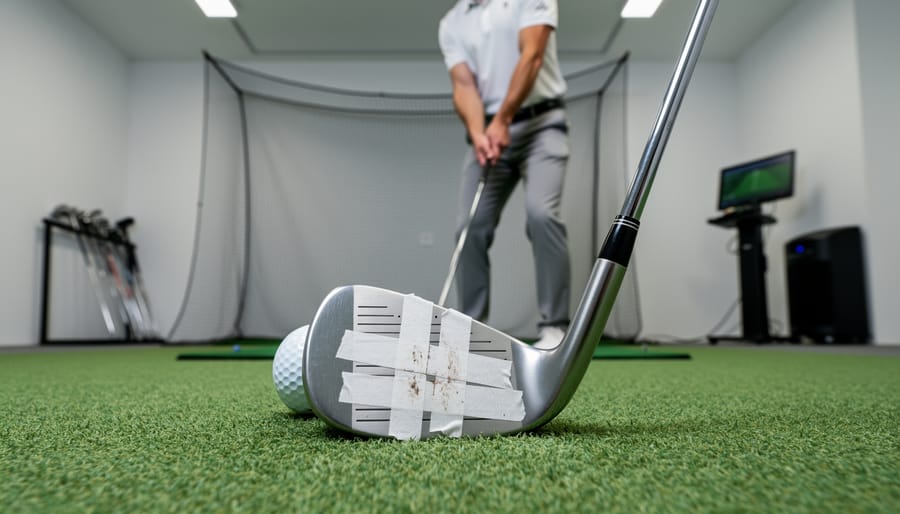
The most common culprit behind a broken golf swing is an over-the-top move at the start of the downswing, where your club approaches the ball from outside the target line instead of from the inside. This single flaw triggers slices, pulls, loss of distance, and inconsistent contact. The quickest diagnostic check is impact tape: pick some up from your local pro shop and stick it on your clubface. After a few swings, the contact pattern will show exactly where you’re striking the ball, revealing whether you’re hitting the heel, toe, or sweet spot.
If your tape shows heel strikes or a diagonal wear pattern from heel to toe, you’re almost certainly swinging over the top. A centered or slightly toe-side mark suggests you’re on the right path. Modern AI swing analyzers like GolfFix can take the guesswork out entirely, identifying over 45 swing issues automatically through your smartphone camera and providing a personalized improvement plan for problems like shanks, topped shots, fat contact, and hooks. The app is free with optional in-app purchases, making expert-level analysis accessible right on the practice range.
Before you dive into drills and swing thoughts, understand this: fixing your swing isn’t about changing everything at once. Most swing problems stem from one or two root causes, typically in your takeaway, weight transfer, or club path. The step-by-step troubleshooting approach we’ll walk through targets symptoms first, traces them back to their mechanical source, then gives you specific drills you can practice this afternoon on the range. Whether you’re battling a persistent slice that sends balls into the trees or struggling with thin, weak contact, the solution often lies in a single adjustment rather than a complete swing overhaul.
Identifying What’s Wrong: Common Golf Swing Symptoms

Before you can fix your golf swing, you need to identify what’s actually going wrong. Most swing problems announce themselves through consistent ball flight patterns or contact issues that repeat round after round. Recognizing these symptoms is the first step toward targeted improvement.
The most common swing flaw golfers face is the slice, that frustrating left-to-right curve that sends your ball into the trees and costs you precious distance. You’ll know you’re slicing when your ball starts left of target then bends sharply right, often landing 30 or 40 yards off course. Its opposite, the hook, curves dramatically right to left and can be just as destructive to your scorecard.
Contact issues reveal themselves through how the ball reacts at impact. Fat shots occur when your club strikes the ground before the ball, creating a heavy, chunky feeling and robbing you of distance. Topped shots feel thin and produce a low, skittering ball flight that barely gets airborne. The shank, golf’s most feared mishit, sends the ball careening off the hosel at a sharp right angle, often straight into trouble.
- Slice
- A ball flight that curves sharply from left to right for right-handed golfers, typically caused by an out-to-in swing path with an open clubface at impact.
- Hook
- A shot that curves dramatically from right to left for right-handed golfers, resulting from a closed clubface and often an in-to-out swing path.
- Fat Shot
- Contact where the club strikes the ground before the ball, producing a heavy feeling and significant distance loss as turf absorbs the club’s energy.
- Topped Shot
- A thin strike where the club’s leading edge contacts the ball’s upper half, resulting in a low, bouncing trajectory with minimal height.
- Shank
- The ball strikes the club’s hosel instead of the face, sending it sharply right at nearly 90 degrees, often the most demoralizing mishit in golf.
- Heel Strike
- Impact occurs on the clubface’s heel (nearest the shaft), producing weak shots that lack distance and often fade right.
You might also notice pure directional problems without curve. A push starts right and stays right, while a pull starts left without curving back. Heel strikes feel dead off the clubface and lack the solid compression of center contact, while toe shots produce a similar weak feel from the opposite side of the face. With your driver, sky shots that balloon high and short indicate you’re catching the ball on the crown.
Pay attention to how these symptoms feel and where your divots point. The pattern of your misses tells the story of what your swing is doing wrong.
Why Your Swing Isn’t Working: Root Causes
Most swing breakdowns don’t begin at impact. They start before you even take the club back, with setup flaws you might not notice until you’re hitting one bad shot after another. Understanding where your swing actually breaks down, not just where it looks broken, gives you the clarity to fix it.
The setup often holds the first clues. Stand too close to the ball, and you’ll crowd yourself into a shank. Aim your shoulders left while your feet point right, and you’ve built a slice into your stance before the swing starts. Your grip tells a story too: white knuckles from gripping too tightly lock your wrists and kill clubhead speed, while a grip rotated too far under the shaft closes the face and sends the ball left. At The Lakes, our teaching staff see these setup errors constantly, and they’re easier to fix than you’d think once you know what to look for.
Then there’s the swing itself. Many golfers throw the club “over the top” from the top of the backswing, casting it outside the proper path and across the ball. That outside-in path creates slices, pulls, and weak contact. Others swing too far from the inside, producing blocks and hooks. Both paths miss the sweet spot of a neutral swing plane.
Common root causes that sabotage your swing mechanics include:
- Incorrect grip pressure, too tight freezes the wrists, too loose loses control
- Misaligned stance and shoulders pointing away from the target line
- Over-the-top swing path casting the club outside on the downswing
- Disconnected arms and body moving independently instead of as one unit
- Poor weight distribution staying on the back foot through impact
- Early release flipping the wrists before the ball
- Lack of rotation turning with the arms instead of the core
The connection between your body and the club matters more than most golfers realize. When your arms race ahead of your torso, or your hands flip at the ball instead of leading through impact, you’ve lost the synchronized movement that creates consistent contact. Weight transfer problems compound this: hanging back on your right side (for right-handed golfers) through impact robs you of power and sends the club into the ground behind the ball.
Each of these root causes creates a chain reaction. A tight grip leads to restricted wrists, which forces you to swing with all arms and no body rotation, which prevents proper weight shift, which produces weak, inconsistent contact. Finding your specific weak link in that chain is the key to fixing your swing rather than just treating symptoms.
Diagnosing Your Swing: Tools and Methods
You can’t fix what you can’t measure. Before you start making swing changes, you need to understand exactly what’s going wrong. In 2026, diagnosing your swing is easier and more accessible than ever, with both low-tech and high-tech options that deliver real insight.
Start with the simplest diagnostic tool: face tape. This sticky, thin tape (also called impact tape) attaches to your clubface and leaves a mark showing exactly where the ball makes contact. Pick up face tape from your local pro shop, including The Lakes Golf Club, and apply it before each practice swing. After a dozen shots, you’ll see a clear pattern. Strikes clustered on the heel signal one set of problems; toe hits suggest another. Thin, high marks on the face reveal topped shots, while low marks confirm fat contact.
The beauty of face tape is its brutal honesty. You might feel like you’re making solid contact, but the tape shows reality. Use it during every range session to track improvement as you work through swing fixes.
For deeper analysis, turn to AI-powered swing analyzers. GolfFix, a free app with in-app purchases, uses artificial intelligence to auto-detect over 45 swing issues from video you record on your phone. Point your camera at your swing, and the app provides immediate, detailed analysis, identifying specific flaws like slice, hook, pull, push, loss of distance, skying, fat shots, topping, shanks, and toe shots. It then delivers a personalized improvement plan with targeted shot-fix lessons.
These tools work together. Face tape tells you where you’re striking the ball; AI apps like GolfFix explain why your swing produces that pattern and how to correct it. You don’t need expensive launch monitors or multiple lessons to start diagnosing problems, just a few dollars for tape and your smartphone.
Step-by-Step Fixes for Your Golf Swing

Fixing the Slice and Hook
A slice curves sharply right (for right-handed golfers) because your clubface is open relative to your swing path at impact, while a hook bends left from a closed face position. Start by checking your grip: rotate your hands slightly to the right on the handle so you can see two or three knuckles on your left hand at address. This stronger grip helps square the face through impact.
For slicers, focus on swinging from inside to out rather than cutting across the ball. Place an alignment stick or club on the ground just outside your ball, angled slightly right of your target line. Practice swinging without hitting the stick, which trains an inside path. Feel like you’re swinging toward right field rather than pulling across your body.
Hook problems often stem from an overly strong grip or rolling the forearms too aggressively through impact. Weaken your grip slightly and focus on maintaining a stable left wrist position, avoid letting it flip or collapse at the bottom of your swing. Your swing path may also be too far from inside, so work on a more neutral approach.
Both issues benefit from AI analysis tools like GolfFix, which auto-detects swing path and face angle problems among its 45-plus identifiable issues, giving you immediate feedback on exactly what’s causing your ball flight curve.
Correcting Contact Issues: Shanks, Heel Strikes, and Toe Shots
Off-center contact robs you of distance and control, but the fix is more straightforward than you might think. Start by applying face tape to your clubface before each practice swing, you can pick this up from your local pro shop. The tape reveals exactly where the ball strikes, giving you immediate visual feedback that no amount of guessing can provide.
For shanks and heel strikes, the problem usually stems from standing too close to the ball or losing your posture through impact. Set up with an extra inch of space between you and the ball, then focus on maintaining your spine angle throughout the swing. A simple drill: place a headcover or alignment stick just outside the ball. If you hit it during your swing, you’re moving toward the ball, the root cause of most shanks.
Toe shots typically indicate standing too far away or swaying backward during the downswing. Move slightly closer at address and concentrate on shifting your weight into your front foot through impact. The face tape will confirm when you’ve found the sweet spot consistently.
For persistent issues, modern tools like the GolfFix app can auto-detect specific contact problems and provide targeted drills. The app identifies over 45 swing issues using AI and offers shot-fix lessons for shanks, toe shots, and other contact faults, available free with in-app purchases for more detailed coaching.
Eliminating Fat Shots and Topped Balls
Fat shots and topped balls share a common culprit: poor low point control. When you hit the ground before the ball, you get a fat shot that travels embarrassingly short distances. Top it, and you barely make contact, sending the ball skittering along the turf instead of flying through the air.
The fix starts with your weight transfer. At address, distribute your weight evenly between both feet. As you swing back, resist the urge to sway laterally, your weight should shift to your trail foot without your hips sliding away from the target. On the downswing, the critical move happens: your weight must move forward, toward your lead foot, before impact. This forward weight shift naturally moves your swing’s low point ahead of the ball, ensuring you strike the ball first and the turf second.
Practice this drill on the range: place a tee just in front of your ball. Your goal is to brush the ground after the ball, taking out the tee with your divot. If you’re hitting fat, you’ll strike the ground before reaching the tee. If you’re topping, you won’t take a divot at all. Face tape on your clubface will confirm whether you’re making solid contact on the sweet spot. With consistent forward weight transfer and proper ball position, just forward of center for irons, you’ll eliminate both fat shots and tops while creating the ball-first contact that produces crisp, satisfying strikes.
Building a Connected, On-Plane Swing
The foundation of a reliable golf swing is connection, your arms and body must move as a unit rather than working independently. When they fall out of sync, you’ll see inconsistent strikes, loss of power, and frustration on every shot.
Start with the most fundamental drill in golf: take the club back low and slow. Position yourself at address, then focus on moving the clubhead away from the ball while keeping it close to the ground for the first twelve to eighteen inches. This low takeaway ensures your shoulders, arms, and hands start together. Many golfers snatch the club up with their hands alone, breaking the connection immediately and throwing the swing off plane.
As you practice this movement, imagine a triangle formed by your shoulders and arms. That triangle should rotate intact during the backswing, not collapse or extend. Your lead shoulder turns under your chin while your trail arm folds naturally, but the relationship between upper body and arms stays constant. This connected rotation is the essence of the single plane concept that produces repeatable, powerful strikes.
Check your connection with this simple test: place a headcover or glove under your lead armpit at address, then make half swings. If the object stays in place through your backswing, you’re maintaining connection. If it drops, your arms are separating from your body rotation, and your swing plane suffers.
Fixing Driver-Specific Issues
Driver problems often stem from setup mistakes that amplify swing flaws. Start with tee height: for modern drivers, position the ball so half sits above the crown at address. Too low encourages a steep, descending blow that creates sky shots and reduces distance. Too high promotes an uppercut swing that robs you of control.
Ball position matters more with the driver than any other club. Place it opposite your lead heel, not in the middle of your stance. This forward position allows you to catch the ball on the upswing, maximizing launch angle and distance. If you’re hitting weak pop-ups that balloon skyward, check whether your ball is teed too high or positioned too far back.
Sky shots, those embarrassing drives that leave a mark on top of your clubface, signal an excessively steep angle of attack. Widen your stance slightly and feel your weight stay centered during the backswing rather than swaying toward your trail foot. This shallower approach prevents the driver from chopping down on the ball. Study Rory’s driver swing to see how elite players maintain width and sweep through impact rather than hitting down.
Face tape reveals exactly where your driver strikes the ball, showing whether you’re catching it high on the face or missing the sweet spot entirely.
Practice Drills You Can Use at The Lakes
The Lakes Golf Club’s practice facilities offer the ideal setting to rebuild your swing mechanics through focused, deliberate practice. The scenic views across the water create a relaxed atmosphere that encourages the kind of patient, repetitive work necessary for lasting swing changes. Whether you’re adjusting your grip, fixing your path, or building better connection, structured drills accelerate your progress far more than mindlessly hitting buckets of balls.
Start each practice session with these five essential drills in sequence:
- Alignment Check Drill: Place alignment sticks on the ground, one pointing at your target, one parallel to your toe line. Check that your feet, hips, and shoulders align parallel left of target before every practice session to groove proper setup habits.
- Connection Drill: Take the club back low and slow for a correct connected swing by tucking a towel under both armpits and keeping it there throughout your backswing. This forces your arms and body to move together rather than independently.
- Impact Tape Ball Striking: Apply face tape to your clubface and hit 10-15 shots, checking your strike pattern after each few swings. The immediate feedback shows whether you’re catching the ball on the heel, toe, or sweet spot, allowing real-time adjustments.
- Slow-Motion Swing Rehearsal: Between full-speed reps, make ultra-slow practice swings focusing on the specific fix you’re implementing, whether that’s grip pressure, wrist hinge, or weight shift, to build muscle memory without the distraction of ball flight.
- On-Course Pressure Practice: Finish each range session by imagining specific holes at The Lakes and hitting the shots you’d face, adding mental pressure that mimics real play and tests whether your swing holds up beyond mechanical drills.
For golfers working on a senior swing that prioritizes smooth tempo over speed, the tempo drill using a three-count rhythm proves especially valuable. Record yourself with your phone between sets to verify changes are actually happening, not just feeling different. Consistent practice three times weekly produces noticeable improvement within two weeks.
Preventing Future Swing Problems

Once you’ve fixed your swing, the real work begins: keeping it healthy. Small flaws creep back in when you’re not watching, especially if you play frequently without dedicated practice. A consistent maintenance routine prevents your swing from deteriorating and saves you from having to rebuild it later.
Start each round with a proper warmup routine. Arrive at The Lakes Golf Club’s practice range twenty minutes early to loosen up and find your rhythm before teeing off. Begin with half-swings using a wedge, focusing on tempo and clean contact, then gradually work up to full swings with longer clubs. This isn’t just physical preparation, it’s a swing check that tells you what adjustments you need before the round matters.
Regular practice habits matter more than marathon range sessions. Thirty focused minutes twice a week beats two hours of mindless ball-beating. During practice, revisit the fundamentals that fixed your swing initially: check your grip, verify your alignment with sticks, and monitor strike patterns with face tape from the pro shop. Use the same diagnostic tools that helped you identify problems, whether that’s face tape revealing heel strikes or the GolfFix app’s AI detection of emerging flaws among its 45+ swing issues.
Schedule periodic swing checks every six to eight weeks. Film your swing from down-the-line and face-on angles to spot changes in posture, plane, or sequencing. Compare current footage to when your swing felt solid. This self-audit catches drift before it becomes dysfunction.
Know when to seek professional help. If you notice consistent new patterns, sudden slicing after months of straight shots, or loss of distance without explanation, book a lesson with The Lakes Golf Club’s teaching professionals before the problem embeds itself. They’ll identify what you can’t see and provide targeted corrections. Think of these tune-ups like regular vehicle maintenance: preventive care keeps everything running smoothly and teaches you how to play your best golf long-term.
Build these habits into your routine, and your improved swing stays with you round after round, season after season.
At-a-Glance Details
This quick-reference table helps you match your swing problem to the right fix and track your improvement:
| Swing Problem | Primary Cause | Quick Diagnostic | First Fix to Try |
|---|---|---|---|
| Slice | Outside-in swing path with open clubface | Ball curves right (for right-handers) | Strengthen grip, swing more from inside |
| Fat Shots | Weight stays on back foot, club bottoms out early | Divot before ball, loss of distance | Shift weight forward through impact |
| Heel Strikes/Shanks | Standing too close or swinging over the top | Use face tape from your pro shop to see strike pattern | Stand slightly farther from ball, take club back low and slow |
| Loss of Distance | Poor sequencing or lack of body rotation | Ball flight feels weak despite solid contact | Focus on hip rotation leading the downswing |
| Inconsistent Contact | Disconnected swing, hands acting independently | Download GolfFix app (free with in-app purchases) for AI analysis | Practice connected takeaway drill with alignment stick |
Regular practice targeting your specific issue accelerates improvement far more than unfocused range sessions. The scenic practice facilities at The Lakes Golf Club provide an ideal environment to work through these fixes methodically. Walking the course during practice also helps you lose weight with golf while building the stamina needed for consistent swing mechanics throughout your round.
Common Questions About Fixing Your Golf Swing
How long does it take to fix my golf swing?
Most golfers see noticeable improvement within two to four weeks of focused practice, though the timeline depends on the severity of the flaw and how often you practice. Simple fixes like grip adjustments can click in days, while rebuilding an entire swing pattern might take several months of consistent work.
Do I need a golf instructor to fix my swing?
Not necessarily, though a qualified instructor accelerates progress and prevents you from ingraining compensations. Many golfers successfully self-correct using diagnostic tools like face tape from your local pro shop and AI coaching apps such as GolfFix, which can auto-detect your flaws and provide immediate, detailed analysis along with a personalized improvement plan.
How do I fix my golf swing on a driver?
Driver issues often stem from incorrect tee height, ball position too far back, or an excessively steep angle of attack. Position the ball off your front heel, tee it high enough that half the ball sits above the crown, and focus on sweeping through impact rather than hitting down, your low point should be well before the ball.
How do I fix a ladies’ golf swing problem with heel strikes?
Heel strikes typically indicate standing too close to the ball at address or losing your spine angle during the swing. Step slightly farther from the ball, maintain your posture through impact, and use face tape to monitor strike location as you practice, once you see centered contact patterns on the tape, you know the adjustment is working.
What is an out-of-sequence golf swing and how do I fix it?
An out-of-sequence swing happens when your arms, body, and club move independently rather than in coordinated order, usually with the arms racing ahead or the body spinning too early. Fix it by taking the club back low and slow for a correct connected swing, ensuring your shoulders, arms, and hands move together as one unit rather than firing separately.
Can AI apps really help fix my swing?
Yes, modern AI tools have become genuinely useful for swing diagnosis and correction. The GolfFix app, for instance, identifies over 45 swing issues using AI and delivers shot-fix lessons targeting specific problems including slice, hook, pull, push, loss of distance, skying, fat shots, topping, shanks, and toe shots, all available free with optional in-app purchases for advanced features.
Where can I get impact tape and training aids?
You can collect face tape from your local pro shop, where staff can also recommend other useful training aids for your specific issues. The Lakes Golf Club’s pro shop carries a selection of diagnostic tools and practice aids, and our teaching professionals can guide you toward the most effective options for your game.
These questions reflect the real concerns golfers bring to the practice range and the lesson tee. The answers cut through theory to give you actionable direction, whether you’re working on your own or seeking professional help. Technology has made swing diagnosis more accessible than ever, but the fundamentals remain the same: identify the problem accurately, understand why it happens, apply the right fix, and practice with purpose until the correction becomes automatic.
Fixing your golf swing doesn’t have to be a mystery or a months-long struggle. With the right approach, identifying symptoms, understanding root causes, and applying targeted practice, you can transform those frustrating mis-hits into solid, confident strikes. The tools available in 2026, from simple face tape you can pick up at any pro shop to sophisticated AI apps like GolfFix that analyze your swing and build personalized improvement plans, make diagnosis faster and more accessible than ever before.
The most important step is taking action. Whether you start with the low-and-slow takeaway drill to build connection or use impact tape to see exactly where the club meets the ball, each practice session moves you closer to the swing you want. The Lakes Golf Club offers the perfect environment to put these fixes into practice, with scenic practice facilities where you can work through drills without pressure, and experienced teaching professionals who can provide that crucial expert eye when you need it.
Remember, a better swing isn’t just about lower scores. It’s about enjoying your rounds more, feeling confident as you address each shot, and sharing memorable experiences with family and friends on the course. The work you put in now pays dividends every time you tee it up, turning golf from a source of frustration into the rewarding, beautiful game it should be.