

Mastering Jimmy Stanger’s golf swing comes down to three proven fundamentals: proper footwork mechanics, understanding the relationship between launch angle and spin rate, and recognizing that the modern swing requires more than a simple turn-and-rotate motion. While Stanger continues to demonstrate his competitive ability on tour with precise iron shots and clutch putting, his approach to swing mechanics offers valuable lessons for golfers looking to improve ball-striking consistency and course management.
Stanger’s recent performances showcase the practical results of sound swing principles. His tee shot on a 223-yard par-3 that landed just under seven feet from the pin wasn’t luck or raw power; it reflected the kind of control that comes from repeatable mechanics. When he holed out from the fairway at the Cognizant Classic or sank a 30-footer at the 3M Open, those moments built on a foundation of technique worth studying.
The swing concepts gaining attention in the golf community center on adjustments any player can practice. Decreasing launch angle to increase spin rate, for instance, provides more control on approach shots, particularly into elevated or firm greens. The subtle drag of the right foot during the backswing creates stability and helps maintain the proper swing plane without restricting rotation. These aren’t complicated tour-only secrets; they’re adjustments that translate from the practice range to Sunday morning rounds with your family at your home course.
What makes studying tour players valuable isn’t trying to copy every detail of their motion. Instead, it’s identifying the principles behind consistent ball-striking and adapting them to your natural swing. This guide breaks down those fundamentals into clear, actionable steps you can verify on the range before taking them to the course.
What You’ll Need to Practice the Stanger Swing Approach

You don’t need specialized equipment to work on the swing principles demonstrated in Stanger’s successful play. The same clubs you already carry will work fine, whether you’re practicing at a range or testing the approach during a round at The Lakes Golf Club.
Essential Items:
- Your current set of irons and wedges for practicing the spin-rate adjustments
- A supply of range balls or your preferred playing balls to maintain consistent feedback
- Tees for working through setup positions without ground interference
- A smartphone or tablet to record your swing from down-the-line and face-on angles
- Alignment sticks or clubs laid on the ground to reference foot positioning and aim
The video recording capability matters most. When you’re adjusting foot position or rethinking how rotation works in your swing, you can’t feel what you’re actually doing with complete accuracy. A simple tripod or propped-up phone lets you compare your movements against the mental picture you’re building from the verified swing cues.
Access to a practice facility where you can hit full shots helps tremendously. The Lakes Golf Club’s practice areas give you the space to work through changes before taking them to the course, and the varied lies across the three courses let you test whether the adjustments hold up under real playing conditions. You’re not buying new clubs or investing in training aids; you’re using what you have to apply specific, proven swing thoughts that have produced measurable results.
Important Swing Fundamentals Before You Start
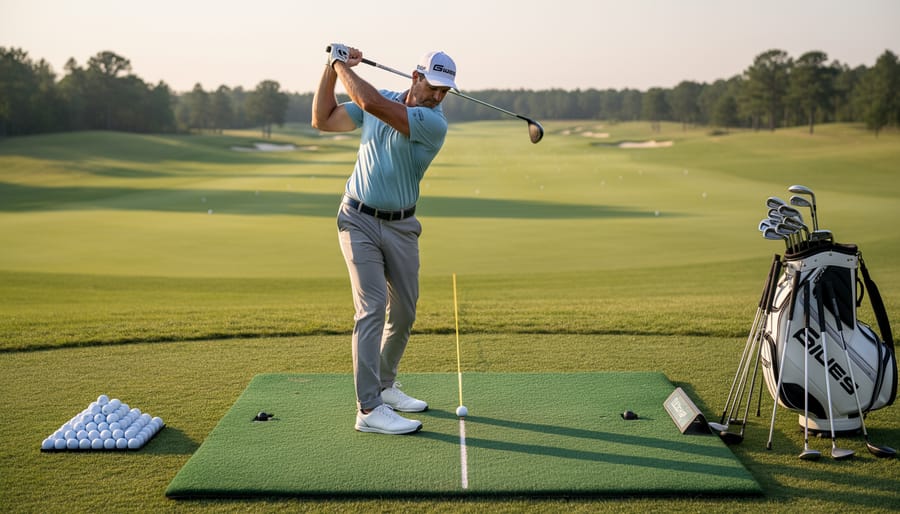
Before you implement any swing changes, understand that modifying your technique carries real injury risk if approached carelessly. Golf swings generate significant torque through your spine, shoulders and hips, jumping straight into new movements without preparation can strain muscles and connective tissue that aren’t accustomed to the different loading patterns.
The verified swing principles we’ll explore, adjusting launch angle, rethinking rotation, and refining foot positioning, require patience to integrate properly. Trying to overhaul everything at once creates confusion and tension. Your body already has ingrained movement patterns; forcing dramatic changes under pressure typically produces compensation movements that undermine the very technique you’re trying to build.
Focus on one element at a time during practice. If you’re working on the foot positioning cue, let that be your sole focus for several sessions before layering in launch angle adjustments. This methodical approach prevents the frustration of attempting too much simultaneously and allows each change to become natural before adding the next.
Resist the temptation to chase distance immediately. The technique principles that produced Stanger’s documented results, the 223-yard accuracy on the par-3 seventh, the fairway hole-out on the 14th, came from refined mechanics, not brute force. Overswinging to generate extra yardage destroys the timing and sequencing that make the approach work. Trust that controlled, well-executed movements will deliver better outcomes than violent effort ever will.
The Core Swing Principles from Stanger’s Approach
Jimmy Stanger’s swing approach rests on three principles that challenge conventional instruction. Understanding these concepts helps explain why his game produces consistent results, accurate approaches, makeable birdie opportunities, and the occasional spectacular shot like his fairway hole-out at the 2026 Cognizant Classic.
The first principle addresses how golfers conceptualize rotation. The swing is not simply “turn and then turn,” a mental model many players adopt early in their development. This oversimplification misses the sequencing, weight transfer, and timing that create consistent ball-striking. Stanger’s approach recognizes that effective rotation involves coordination between upper and lower body, not just rotating back and rotating through. This nuanced understanding likely contributes to his ability to set up birdie putts from favorable distances, like the 11-foot opportunity he created at the Rocket Classic.
The second principle focuses on ball flight control through launch conditions. Decreasing launch angle increases spin rate, a relationship that affects shot shape, distance control, and stopping power on greens. Higher spin rates give players more control over trajectory and landing behavior, explaining why Stanger can consistently place tee shots close to pins on challenging par-3s like the 223-yard seventh hole where he landed 6 feet 11 inches from the cup.
The third principle involves a subtle setup adjustment: dragging the right foot back slightly during address. This minor positioning change affects stance alignment, hip angle, and swing path without requiring dramatic alterations to fundamentals. It’s the kind of small adjustment that experienced players make to fine-tune ball flight and strike quality.
These principles work together rather than in isolation. The foot position influences rotation quality, which in turn affects launch conditions and spin rates. Stanger’s documented success, including a 30-foot birdie conversion on No. 17 at the 3M Open, demonstrates that sound swing principles produce results across different situations and course conditions.
Step-by-Step: Building the Swing Sequence

Setup and Foot Positioning
The right foot positioning cue from Stanger’s swing advice centers on a subtle adjustment at address: drag your right foot back slightly from its normal square position. This isn’t about measuring inches, it’s about creating a feel that helps your body move more naturally through the swing.
Start by setting up as you normally would, then experiment with pulling your right foot back a fraction. You’re looking for a sensation of slight openness in your stance without dramatically changing your alignment to the target. The adjustment should feel almost imperceptible; if it looks extreme, you’ve gone too far.
This small shift influences how your hips and shoulders can rotate. Rather than forcing a turn from a rigid, perfectly square stance, the modified position allows your body to move more freely. You’ll notice the difference in your balance, weight transfer becomes more fluid, and the sequencing feels less mechanical.
Test the feel by making slow-motion swings. Your setup should feel athletic and ready, not locked. The goal is comfort and balance, not a specific template.
Rethinking the Turn
The simplest swing thought, “turn back, turn through”, feels intuitive, but it oversimplifies what creates consistent contact and power. The verified swing advice emphasizes that the golf swing is not simply turn and then turn. This distinction matters because thinking only about rotation can disconnect the upper and lower body, producing inconsistent strike patterns and missed opportunities for both distance and accuracy.
Instead of treating the backswing and downswing as mirror-image rotations, focus on how different body segments move in sequence. The backswing loads energy through coil, while the downswing releases that energy through proper sequencing, lower body initiating first, torso following, arms and club trailing. This separation creates lag and allows the clubface to arrive at impact with optimal angle and speed.
The key is understanding that rotation serves the delivery of the club to the ball, not the other way around. When you emphasize weight transfer and sequenced movement rather than pure rotation, you create the conditions for the decreased launch angle and increased spin rate that produce penetrating ball flight. Watch how your lower body moves first on the downswing, this firing order, not rotational range, determines strike quality and consistency.
Managing Launch Angle and Spin
The verified swing advice, decrease launch angle to increase spin rate, translates into practical adjustments you can implement without getting lost in technical measurements. This principle affects how the club meets the ball, creating the compression and spin that Stanger demonstrated when holing out from the fairway at the Cognizant Classic’s par-4 14th.
Start with ball position. Moving the ball slightly back in your stance encourages a steeper angle of attack, naturally lowering launch while increasing spin. You’re not repositioning it dramatically, perhaps an inch toward your back foot from where you’d normally play an iron shot. This adjustment helps the clubface contact the ball before the swing reaches its lowest point.
The delivery angle comes from maintaining wrist hinge longer through impact rather than releasing it early. Think about sustaining the angle between your lead forearm and the club shaft as you approach the ball. This forward shaft lean at contact produces the descending blow that compresses the ball against the turf, generating spin.
You’ll know you’re achieving the right combination when ball flight appears more penetrating rather than ballooning, and you notice cleaner divots forming ahead of where the ball rested. The increased spin gives you control, the same characteristic that let Stanger consistently set up makeable birdie opportunities from 11 feet or closer.
Applying the Technique on the Course
Taking the swing mechanics you’ve refined on the range and applying them under course pressure requires a shift in mindset. Real golf holes demand you execute while managing distance, hazards, wind and the mental weight of scorecard consequences. This is where Stanger’s documented results offer a practical roadmap.
Par-3s become immediate testing grounds for the launch-and-spin principles. Stanger’s accuracy on the 223-yard par-3 seventh hole landing just under seven feet from the pin, shows what controlled ball flight delivers when wind or elevation enters the equation. On longer one-shotters, prioritize solid contact with the adjusted launch angle over trying to muscle extra distance. The spin you generate keeps approach shots from rolling through greens, particularly on firm surfaces or downwind holes.
Birdie opportunities arise from creating manageable putt distances, not miraculous recovery shots. Stanger’s tee shot on the par-3 eleventh that set up an 11-foot birdie chance demonstrates the value of precision over heroics. Aim for the fat part of greens when pin positions punish aggressive lines, trusting your improved ball control to leave putts inside 15 feet rather than chasing tight to every flag.
Course management at venues like The Lakes Golf Club rewards this measured approach. Use course practice rounds to identify holes where your improved accuracy creates genuine scoring chances versus those requiring conservative play. The three distinct courses offer varied scenarios: tight tree-lined fairways where shot shape matters, open holes where wind management tests your launch control, and risk-reward par-5s where reliable distance opens up two-shot possibilities.
Track specific outcomes rather than vague feelings. Count greens hit, note your average proximity on approaches from scoring range, and watch whether you’re converting more birdie putts from comfortable distances. These concrete measures reveal whether your technical work translates to lower scores.
How to Know If It’s Working
You’ll recognize improvement through concrete changes in your scoring and ball flight. Track these performance indicators over several practice sessions and rounds:
- Tighter grouping of approach shots, with more landing within a 20-foot radius of your target
- Increased greens in regulation, particularly on par-4s and par-5s where approach accuracy matters most
- More birdie putts inside 12 feet, similar to the makeable opportunities Stanger creates
- Improved ball flight control with lower, penetrating trajectories rather than ballooning shots
- Fewer extreme misses to one side, indicating better swing path consistency
The most telling sign? You’ll start hitting shots that feel effortless yet travel the expected distance with better control. When you consistently create scoring opportunities from favorable positions, the technique is working.
If you’re not seeing progress after four to six weeks of focused practice, consider professional instruction. A coach can identify whether you’re implementing the principles correctly or if your setup needs adjustment. Sometimes a small correction in how you’re applying the foot position or rotation sequencing makes the difference.
The Lakes Golf Club’s three courses provide excellent testing grounds for these improvements. The varied conditions across the Mountain, Lake, and Valley courses let you verify your technique under different circumstances. Remember that swing changes require patience, Stanger’s documented success with precise approach shots and fairway hole-outs came from refining fundamentals, not chasing quick fixes.
If old habits resurface or you plateau, resources like our guide on how to fix your swing can help diagnose what’s interrupting your progress. The goal isn’t perfection but consistent improvement in the outcomes that matter: tighter dispersion, better scoring position, and more confidence over the ball.
Common Questions About the Stanger Swing Approach
How long does it take to see improvement with this approach?
Most golfers notice changes in ball flight within a few practice sessions, but integrating the technique into consistent on-course performance typically requires several weeks of deliberate practice. The key is focusing on one principle at a time rather than attempting all adjustments simultaneously.
Does this swing approach work for higher handicappers?
The core principles, refined rotation sequencing, launch angle management, and setup fundamentals, apply across skill levels. However, golfers struggling with basic contact should establish a consistent strike pattern before attempting these more nuanced adjustments.
How does this differ from conventional swing instruction?
Rather than prescribing specific positions or swing plane angles, this approach emphasizes understanding what the swing accomplishes (spin rate, trajectory control, sequencing) over memorizing geometric checkpoints. It’s less about copying exact positions and more about grasping the cause-and-effect relationships that produce quality shots.
Do I need specialized coaching to learn this technique?
While professional instruction can accelerate progress and catch developing flaws, the principles outlined here are accessible for self-directed practice. Video review with your smartphone provides sufficient feedback for most golfers to monitor setup adjustments and swing sequencing, though personalized guidance helps if progress stalls.
The real test comes through measurable performance changes rather than how the swing feels or looks. If you’re hitting more greens from distance, creating birdie chances from manageable putt lengths, and controlling trajectory more reliably, the technique is taking hold regardless of whether you’ve consulted an instructor.
Remember that Stanger’s documented success, accurate approach shots, fairway hole-outs, converted birdie opportunities, came from applying sound fundamentals consistently, not from chasing perfection on every swing element at once. Start with the adjustment that addresses your most pressing ball-flight issue, whether that’s inconsistent contact, excessive ballooning, or directional scatter, and build from there.
The swing principles demonstrated by Jimmy Stanger’s play, decreasing launch angle to increase spin rate, understanding the swing as more nuanced than simple rotation, and subtle adjustments like the right foot positioning, prove themselves through results. His documented success includes holing out from the fairway on a par-4, landing approaches within makeable birdie range, and creating consistent scoring opportunities. What matters most is that these concepts work without requiring complex technical knowledge or specialized training.
The beauty of this approach lies in its accessibility. You don’t need to measure launch angles in degrees or understand biomechanics to apply these principles. Focus on what you can feel and observe: how your shots respond to setup changes, whether your ball flight becomes more controllable, and whether you’re creating more scoring chances from favorable distances. Start with one element, integrate it gradually, and let the results guide your refinement.
The Lakes Golf Club offers an ideal environment to put these techniques into practice. With three distinct courses ranging from championship-caliber challenges to family-friendly layouts, you’ll find varied conditions that let you test different aspects of the approach. The practice facilities give you space to experiment without pressure, while the on-course application reveals what truly works in your game.
Effective golf technique isn’t about chasing perfect positions. It’s about understanding principles that consistently produce better outcomes. Take what you’ve learned, head to the range, and discover which adjustments genuinely improve your ball-striking and scoring opportunities.