

The Happy Gilmore golf swing is exactly what it sounds like: a running start into your drive that channels the hockey-slapshot technique Adam Sandler made famous in 1996. What began as pure comedy has evolved into a legitimate training drill endorsed by tour professionals like Padraig Harrington, who explains that practicing this exaggerated motion can drastically improve your lower body mechanics and generate serious clubhead speed. The technique works by forcing your body into an athletic, sequential movement pattern where the lower body initiates the transition, followed by the torso, arms, and finally the clubhead.
Golf instructors across the country have embraced this unconventional approach. The PGA of America now acknowledges it as a teaching tool, while professionals like Rick Shiels have tested whether it translates to real golf performance. The answer? Absolutely, when used correctly. The Happy Gilmore swing strips away the static setup that traps recreational golfers and replaces it with pure athletic motion. You’ll feel the difference immediately: your hips firing earlier, your weight transferring more aggressively, and your entire kinetic chain working in harmony. Chris Ryan and other instructors have integrated elements of this technique to help students improve ball-striking fundamentals that translate directly to a traditional setup. Whether you’re practicing on a spacious driving range or an open fairway, this drill transforms abstract concepts like “weight shift” and “sequencing” into something your body understands instinctively.
What You’ll Need to Practice the Happy Gilmore Swing

You don’t need much specialized equipment to start practicing the Happy Gilmore swing, just the fundamentals plus a bit of extra space. The running approach creates unique demands compared to a stationary stance, so choosing the right setup from the start will help you develop the technique safely and effectively.
- A mid-iron (7-iron or 8-iron) to start, before progressing to woods or driver
- Athletic golf shoes with good traction to handle the running approach and sudden plant
- A driving range with open hitting bays and adequate room behind your station for your approach steps
- Plenty of practice balls, since you’ll be working on timing and rhythm rather than perfecting every shot
- Enough lateral space to ensure your running path won’t cross into neighboring bays
Start with a mid-iron rather than a driver. The shorter shaft gives you better control as you learn to coordinate the footwork with impact, and you can always work up to longer clubs once the motion feels natural. Your footwear matters more here than in a standard swing, you need shoes that can grip during your approach steps and especially when you plant your lead foot. Regular golf shoes work fine, but make sure the spikes or tread pattern aren’t worn down.
The driving range is the only sensible place to practice this technique. You need room behind your hitting station for a few approach steps, and the controlled environment lets you focus on mechanics without worrying about course etiquette or pace of play. Choose a bay with open space on both sides if possible, since your running path and follow-through will take up more room than a conventional swing.
Safety Considerations and Practice Guidelines

Before you channel your inner Adam Sandler and sprint toward a golf ball, understand that the Happy Gilmore swing demands more control and awareness than a conventional swing. The running approach shifts your center of gravity rapidly and loads weight differently, which can challenge your balance and coordination, especially if you’re new to this athletic motion. While pros like Padraig Harrington use it to improve lower body mechanics, they practice it in controlled settings with clear safety parameters.
Give yourself at least fifteen feet of clear space behind and to the sides of your ball, the running start means you’re covering ground quickly, and you need room to recover if your momentum carries you forward or off-balance. Check that no one is within range of an errant shot, because the power generated through this technique can send a mishit ball unpredictably. If you have knee, hip, or ankle issues, recognize that the explosive footwork and sudden weight transfer place significant stress on these joints. This drill isn’t about proving you can swing like a movie character; it’s a training tool to develop athletic motion and improve how your lower body initiates the swing sequence. If the running approach feels awkward or unstable after a few attempts, slow it down to a controlled walk-through or skip it entirely, there’s no shame in using safer drills to protect your body while still working on power and sequencing.
Treat this as a training exercise, not a party trick. You’re building feel for how the lower body drives the swing, not trying to outdrive your buddies with a running start.
Step-by-Step: Building Your Happy Gilmore Swing
Setting Your Starting Position and Stance
Start by standing about 15-20 feet behind the ball, far enough to build momentum through your running approach, but not so distant that you lose control or speed before contact. Think of it as a casual jog’s worth of space, similar to a bowling approach.
Your initial stance should feel relaxed and athletic. Face the target line with your shoulders square, feet shoulder-width apart, and knees slightly bent. Hold your driver with a normal grip, letting the club rest naturally in front of you or to your side, whichever feels most comfortable as you prepare to move forward.
The key is starting from a neutral, balanced position. Your weight should be evenly distributed, not leaning forward or back. This gives you a stable platform to begin your run without stumbling or rushing. Unlike a traditional swing where you’re already addressed over the ball, you’re setting up in a standing position that allows natural forward movement.
Take a moment to visualize your path to the ball and your target line. Your starting position should align your body so that when you plant and swing, everything flows naturally toward the target without needing mid-motion adjustments.
Mastering the Footwork and Running Approach
The footwork is where the Happy Gilmore swing earns its name, and where most golfers either unlock real power or lose their balance entirely. Start about three to four paces behind the ball, far enough to build momentum without racing into an uncontrolled sprint.
Take three deliberate steps toward the ball, accelerating gradually with each one. Think of it as a controlled jog rather than an all-out dash. Your first step is slow, the second picks up speed, and the third plants your lead foot firmly just as you would in a traditional swing setup. This progression lets you channel forward energy into rotational power instead of lurching past the ball.
The plant is everything. When your lead foot hits the ground, typically your left foot for right-handed golfers, it should land with your weight on the inside edge, knee slightly flexed, ready to brace against the ground. This anchored position converts your running momentum into the explosive lower-body rotation that initiates the swing sequence. If your foot slides or your knee collapses, you’ll bleed power before you even reach impact.
Timing takes practice. Most beginners rush the plant and swing before their body has stabilized, or they slow down too much and lose the whole point of the running start. The sweet spot is planting firmly enough to stop your forward motion while immediately rotating through the ball. Start with half-speed run-throughs until the rhythm feels natural, then gradually increase your pace as your balance improves.
Coordinating Body Mechanics Through Impact
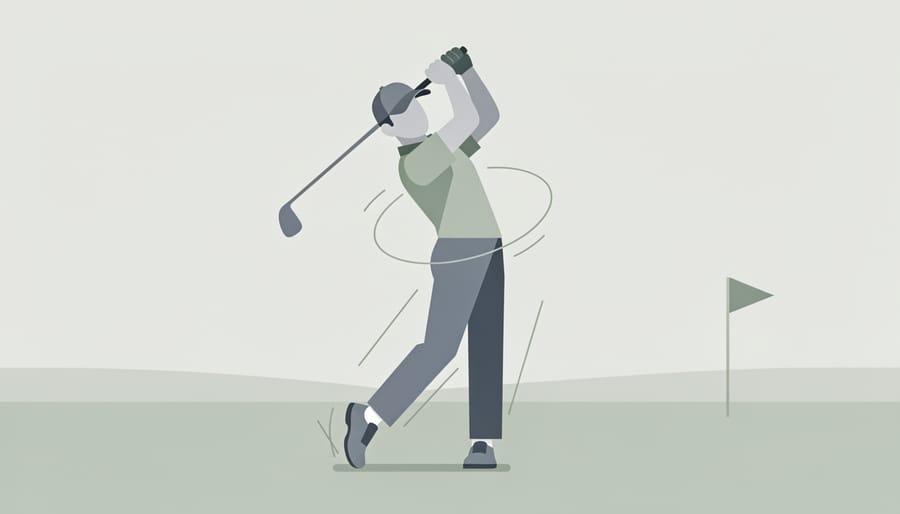
The running start sets you up for power, but the impact zone is where that energy actually transfers to the ball. Your lower body initiates everything, just as your lead foot plants, drive your hips forward and begin rotating them toward the target. This weight transfer from your trail side creates the foundation for everything that follows.
As your hips open, your torso responds by rotating through the hitting area. Don’t rush this sequence. The momentum you built during your running approach should flow naturally from your lower body up through your core. Your arms and the club lag slightly behind, they’re passengers at this stage, not the engine.
The clubhead releases last in this chain. Many first-timers try to muscle the club with their hands, but that destroys the kinetic flow. Instead, let your wrist hinge maintain until the last moment, then release naturally as your body rotation pulls your arms through impact.
Think of it like cracking a whip: the handle moves first, then the energy travels down the length until it snaps at the tip. Your hips are the handle, your torso is the middle section, and the clubhead is that final snap. When the sequence fires correctly, you’ll feel the club almost swing itself through the ball rather than you forcing it.
Simple Drills to Develop the Motion
Start with the step-back drill to isolate footwork without overthinking impact. Take your normal address position, then step back three paces from the ball. Practice your running approach and stop at the point where you’d normally make contact, no club needed. Focus on timing your steps so your lead foot plants firmly just as your imaginary swing begins. Once that rhythm feels natural, add a club and repeat, letting momentum flow through your body.
The pause drill helps synchronize the kinetic chain. Execute your running approach and plant your lead foot, but freeze for a full second before swinging. This exaggerated pause trains your lower body to anchor properly while your upper body loads. You’ll feel tension in your hips and core, that’s the coil you want. Gradually reduce the pause until the motion becomes fluid.
For building speed, try the progression drill. Start with a single shuffle step from your setup position, make contact, then add another step once you’re comfortable. Work up to the full three-step approach over multiple sessions. This gradual build prevents you from rushing the motion before your body understands the sequence Harrington emphasizes: lower body drives, torso follows, arms release last.
How to Know It’s Working and What Comes Next
You’ll know the Happy Gilmore swing is working when you feel a distinct athletic rhythm, a smooth transfer of momentum from your running approach into the ball strike. Watch for increased clubhead speed without forcing the swing, and pay attention to whether your lower body naturally initiates the downswing sequence. If you’re consciously thinking about your arms or hands during impact, you’re likely overriding the lower-body mechanics that make this drill valuable.
The real benefit shows up in your regular swing. As Padraig Harrington emphasizes, practicing the Happy Gilmore can drastically improve your lower body mechanics in everyday golf. You might notice better weight shift, more natural hip rotation, and improved timing between your lower and upper body, even from a stationary stance. Many golfers find they’ve unconsciously corrected swing off causes related to upper-body dominance or poor sequencing.
Transitioning back to practical golf means keeping the athletic feeling without the literal run-up. Start by taking a single step forward before your regular swing, then gradually reduce that to a weight shift in place. The kinetic chain you’ve developed, lower body, torso, arms, clubhead, should remain intact. This isn’t about permanently swinging like Happy Gilmore on the course; it’s about unlocking the power sequence that comes naturally when your body moves athletically, then applying that sensation to your conventional technique.
How to Check Your Work
You’ll know the Happy Gilmore swing is working when you feel genuine power transferring from your lower body through impact. Your lead leg should feel engaged and stable at contact, not loose or wobbly. You’re not necessarily looking for perfect ball striking right away, this is an athletic drill first, a scoring shot distant second.
Watch for these positive signs: increased clubhead speed compared to your static swing, a fuller hip rotation through the ball, and that satisfying sensation of ground force propelling your upper body. Your divots (if you’re taking them) should point slightly left of target, indicating proper body rotation rather than all arms.
Video yourself from down the line. The running approach should look controlled, not chaotic. Your timing should be repeatable across multiple swings, even if the contact varies.
If you’re consistently losing balance, falling away from the target, or experiencing any joint discomfort in your knees or lower back, stop immediately. A certified PGA professional can assess your mechanics and determine whether you’re ready for this athletic motion or need to build foundational strength first. They’ll also help you translate any power gains back into your standard swing setup.
Common Questions About the Happy Gilmore Swing
Is the Happy Gilmore swing just a joke, or is it actually useful?
While it originated as comedy, PGA professionals now use it as a legitimate training drill. Padraig Harrington explains that practicing with this running approach can drastically improve your lower body mechanics, and the PGA of America has acknowledged it as a valid lesson component for developing athletic motion in your swing.
Can I use this swing during an actual round of golf?
It’s primarily a training tool rather than a course strategy. The technique helps you understand proper sequencing and build power, but most golfers apply the lessons learned, improved footwork, better lower-body initiation, to their standard swing rather than running up to the ball during competitive play.
What parts of my game will improve from practicing this technique?
You’ll develop better lower-body mechanics and a more athletic motion overall. The exaggerated running start forces you to use your legs and hips correctly, teaching the proper kinetic chain where your lower body initiates the swing, followed by your torso, arms, and finally the clubhead.
Do I need to be in great shape to try this swing?
You don’t need elite athleticism, but you should be comfortable with light jogging and able to maintain balance through dynamic movement. Start with slow, controlled steps before building speed, and if you have mobility concerns or balance issues, work with an instructor who can modify the drill to suit your physical capabilities.
The beauty of this unconventional technique is that it strips your swing down to its athletic essentials. When Rick Shiels tested whether the Happy Gilmore swing works in real golf, he demonstrated that the fundamental principles, timing, sequencing, and explosive lower-body movement, translate directly to better ball-striking. You’re not learning a party trick; you’re developing the same powerful mechanics that tour players work on, just through a more dramatic drill that makes the correct motion impossible to miss.